
Personal trainers may face challenges in communicating with or motivating clients of different personality types. These challenges may be due to an assumption about communication and motivations, namely, that there is a one-size-fits-all approach. The Myers-Briggs Type Indicator (MBTI) challenges this assumption.
By tailoring their coaching style and communication to match the individual needs of each client's personality type, personal trainers can create a more personalized and effective training experience.
The MBTI is a personality assessment tool that identifies an individual's preferences in how they perceive and make decisions. It is based on the theory of psychological types developed by Carl Jung and was created by Isabel Briggs Myers and Katherine Briggs.
The assessment consists of 4 pairs of preferences:
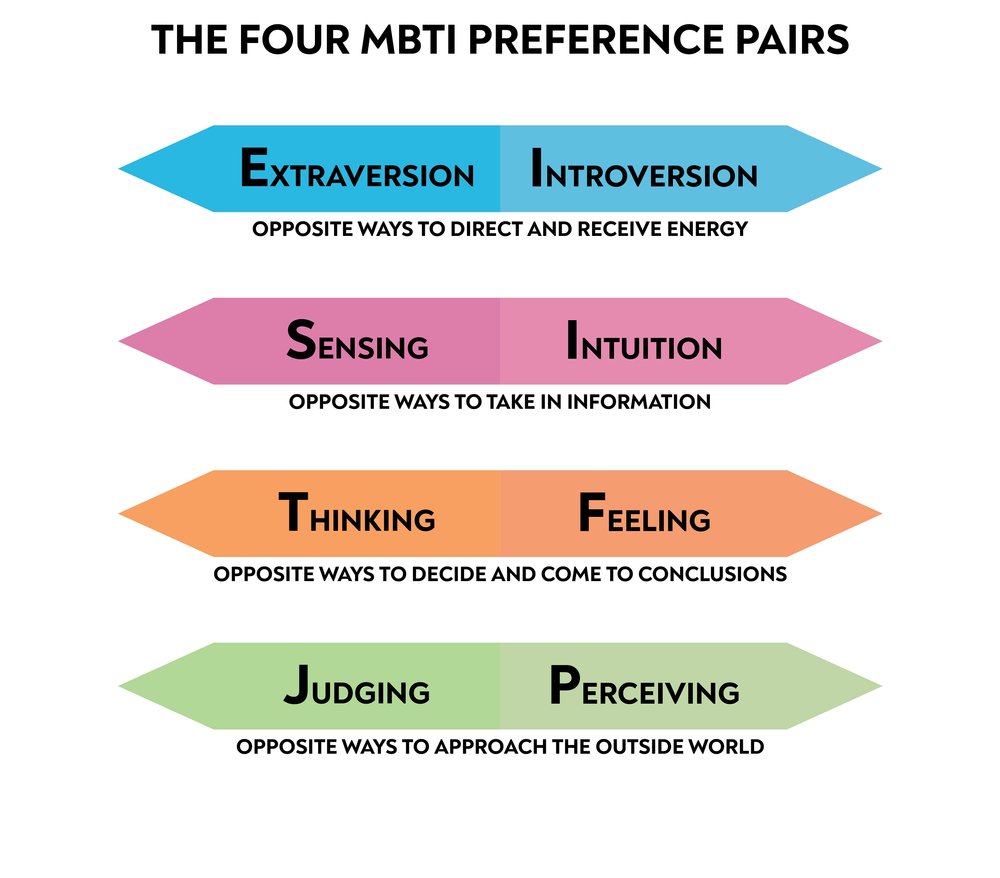
Extraversion vs. Introversion (E or I) - This pair refers to where individuals focus their attention and get their energy.
Extraverts focus on the outer world of people and things.
Introverts focus on their inner world of thoughts and ideas.
Sensing vs. Intuition (S or N) - This pair refers to how individuals take in and process information.
Sensors rely on their five senses to gather information.
Intuitives rely on patterns and possibilities to make sense of the world.
Thinking vs. Feeling (T or F) - This pair refers to how individuals make decisions.
Thinkers rely on logical analysis and objective criteria.
Feelers rely on personal values and subjective considerations.
Judging vs. Perceiving (J or P) - This pair refers to how individuals approach the outer world.
Judgers prefer a planned and organized approach.
Perceivers prefer a spontaneous and adaptable approach.
The systematic combination of these four pairs constitute the 16 personality types of the Myers-Briggs Type Indicator:
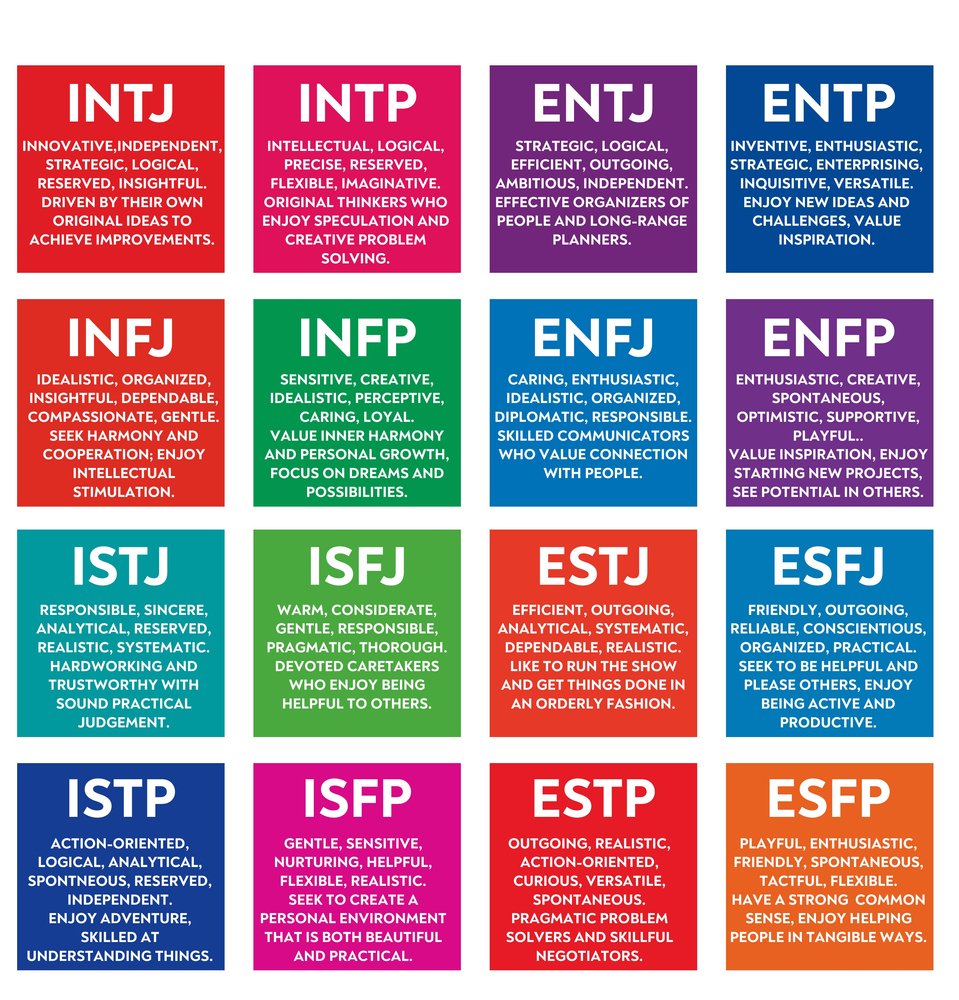
ISTJ - Introverted, Sensing, Thinking, Judging: These individuals are dependable, practical and responsible. They are systematic and orderly in their approach to problem solving and decision making.
ISFJ - Introverted, Sensing, Feeling, Judging: These individuals are loyal, supportive and dependable. They are sensitive to the needs of others and are motivated to help and serve.
INFJ - Introverted, Intuitive, Feeling, Judging: These individuals are compassionate, idealistic and empathetic. They have strong insight into people and situations and are motivated to help others.
INTJ - Introverted, Intuitive, Thinking, Judging: These individuals are analytical, strategic and independent. They have a clear vision of their goals and work towards them efficiently.
ISTP - Introverted, Sensing, Thinking, Perceiving: These individuals are independent, logical and adaptable. They are curious and hands-on learners and are drawn to understanding how things work.
ISFP - Introverted, Sensing, Feeling, Perceiving: These individuals are sensitive, compassionate and artistic. They are in touch with their emotions and appreciate beauty and harmony in the world.
INFP - Introverted, Intuitive, Feeling, Perceiving: These individuals are idealistic, empathetic and curious. They have strong values and are driven to help others and make the world a better place.
INTP - Introverted, Intuitive, Thinking, Perceiving: These individuals are logical, analytical and independent. They are curious and enjoy exploring new ideas and concepts.
ESTJ - Extraverted, Sensing, Thinking, Judging: These individuals are logical, practical and efficient. They are decisive and enjoy taking charge and organizing others.
ESFJ - Extraverted, Sensing, Feeling, Judging: These individuals are outgoing, supportive and dependable. They are sensitive to the needs of others and are motivated to help and serve.
ENFJ - Extraverted, Intuitive, Feeling, Judging: These individuals are outgoing, compassionate and empathetic. They have strong insight into people and situations and are motivated to help others.
ENTJ - Extraverted, Intuitive, Thinking, Judging: These individuals are confident, strategic and assertive. They have a clear vision of their goals and work towards them efficiently, often taking charge and leading others.
ESTP - Extraverted, Sensing, Thinking, Perceiving: These individuals are outgoing, practical and adaptable. They enjoy taking risks and are drawn to understanding how things work.
ESFP - Extraverted, Sensing, Feeling, Perceiving: These individuals are outgoing, spontaneous and artistic. They are in touch with their emotions and appreciate beauty and harmony in the world.
ENFP - Extraverted, Intuitive, Feeling, Perceiving: These individuals are outgoing, curious and idealistic. They have strong values and are driven to help others and make the world a better place.
ENTP - Extraverted, Intuitive, Thinking, Perceiving: These individuals are outgoing, analytical and independent. They are curious and enjoy exploring new ideas and concepts.
These types provide insight into natural tendencies, not fixed definitions. Individuals often shift between types in different situations or stages of life.
For personal trainers, the MBTI is a useful tool. Trainers must understand their clients' strengths and weaknesses to tailor training effectively:
Introverts need more alone time to process thoughts and emotions, while Extraverts thrive in social, interactive training environments.
Sensing types are practical and detail-oriented; Intuition types are imaginative and abstract. Understanding these differences allows a trainer to adapt training strategies to match the client's preferred learning style.
Thinkers and Feelers decide differently. Thinkers rely on logical analysis and impersonal criteria (like data or efficiency), while Feelers consider personal values and the impact on others (like group cohesion or motivation). Aware trainers help clients balance decision-making by incorporating both logic and values.
Judgers and Perceivers approach structure differently. Judgers prefer an organized schedule, while Perceivers prefer flexibility. A trainer who understands these needs can design the optimal training schedule that minimizes friction and maximizes adherence.
Here are some questions based on the MBTI for personal trainers to reflect on and apply:
How does my client's MBTI type influence their preferred communication style, and how can I adjust mine to match? (e.g., How does an Introverted client prefer to receive feedback—in private, written, or focused, direct points—versus an Extraverted client who might prefer immediate, verbal, and public acknowledgment?)
How does the client's MBTI type affect their overall approach to fitness, and what specific design elements will best meet their unique needs and motivations? (e.g., How will a client with a preference for Sensing respond to a detailed, step-by-step workout versus a client with a preference for Intuition who needs to understand the big-picture "why" and long-term possibilities?)
In what specific ways can I leverage my client's MBTI strengths to create a more effective and enjoyable training experience? (e.g., How can I use a client's preference for Feeling—their focus on values and impact—to encourage them to stick with a program long-term by connecting their fitness goals to their personal values or the impact on their family/health?)
How can I use the client's MBTI type to anticipate potential challenges or obstacles in adherence, and how can I proactively address them in the training program? (e.g., How must I adapt a workout program to better suit a client with a preference for Judging—who needs structure and goal-setting—to prevent frustration from unexpected schedule changes or lack of clear milestones?)
What role does my own MBTI type play in my inherent coaching style, and how can I leverage my strengths while managing my weaknesses to best serve the client? (e.g., As a trainer with a preference for Thinking, how can I intentionally adjust my logical, objective approach when communicating with a client who has a preference for Feeling to ensure the message resonates emotionally and addresses their personal concerns?)
Applying the MBTI framework allows personal trainers to abandon the one-size-fits-all approach. By tailoring communication and motivation to client preferences, you ensure greater success and satisfaction.
Reference
Myers, B. I., Myers, B. P. (1995) Gifts Differing: Understanding Personality Type, CPP